8505b7e9e0
flux.vision, tobias.raayoni-last.com and randogoth.com. They were one site until
October 2026, serving four audiences from a single dated list, which is the only
format that can hold unrelated things at once.

flux.vision is recovered from the Wayback Machine, where it had sat since being
deleted in 2021: 90 articles, closed and maintained rather than updated.
tobias.raayoni-last.com is the professional record, 97 articles back to 1999.
randogoth.com is the technical work, 41 articles across six areas, served as an
ANSI bulletin board.

History starts here deliberately. The development history, the 266-row inventory
that records why each article went where it did, the Wayback pipelines, the
pruned articles, the source archives and the full-size images are kept beside
the repo rather than in it, so a clone is the web presence and not the argument
that produced it. REFACTOR.md is gitignored for the same reason. See README.md
for where that material lives, and keep it: the sort is not reproducible from
these three directories alone.

Each site documents itself in its own README, including the traps that cost time
and look like nothing when you get them wrong.
1.6 KiB
Title: Voidcat Algorithm Date: 2024-04-10 23:00 Category: RANDOM Slug: voidcat Summary: A new Rust-based spatial anomaly detection algorithm for Randonautica with open-sourced core geometric analysis components.
The underlying algorithm for Randonautica's anomaly coordinate search is a proprietary library by the Fatum Project written in C++ called libAttract. It does its job but has its limitations and quirks.
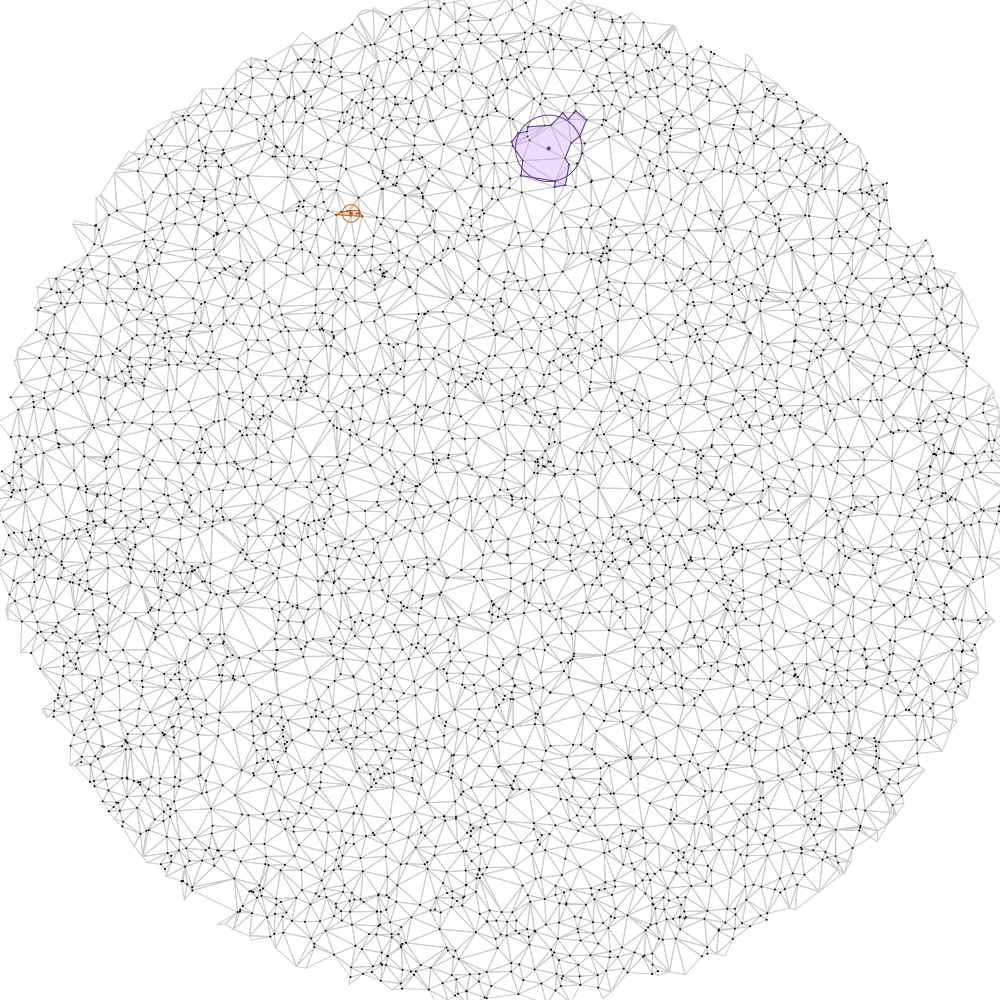
Based on the same mathematical and statistical principles as libAttract I engineered a novel algorithm in the fast, robust and modern Rust programming language. Inspired by the memetic recurrence of cats in void areas of Randonaut trips I called it VOIDCAT, short for Void Objects Identification in Delaunay Complexes with Attractor Tracking.
To implement the Attractor and Void anomaly search I focused on geometric spatial analysis algorithms, particularly utilizing a technique called Delaunay triangulation. The algorithms utilized are primarily the DELFIN algorithm developed in the field of astronomy to map void areas in space and the efficient graph-based spatial clustering algorithm DTSCAN that looks at adjacencies of vertices in a triangulation graph to find clusters in multidimensional point distributions.
While VOIDCAT itself remains proprietary and for Randonautica's exclusive use, I open sourced the Rust implementations of the underlying spatial analysis algorithms in a package called Xenobalanus
Repository